Total Pageviews

Sunday, February 9, 2014

                           Mitosis                                        


Hey guys the bestscienceblog12 here and today I will be talking about Mitosis and cell division. Mitosis is important because it helps your body grow and it replaces old cells with new ones.

Mitosis is the process in which the nucleus divides to form two identical nuclei. Mitosis is in relation to cell division because it is one of the two ways cell divide. The other is miosis.

Before the stages of mitosis begins the genetic material in the nucleus of the cell copies its self. This makes it so that each daughter cell gets the same genetic material as its parent cell.

The first step of mitosis is called interphase. The cell is preparing for mitosis by replicating each chromose in the nucleus. The two copies are called chromotids.


The second phase is called prophase. The genetic material in the cell shortens and thickens. Then little things called centriols spread to oppisite ends of the cell and thread like spindle fibers begin to stretch across the cell.


Third comes the Metaphase. During metaphase the two copies of each chromosome line up in the center of the cell. The chromosomes r then attached to the spindle fibers.


The fourth phase is anaphase. During anaphase the complete sets of chromoses are pulled to oppiste ends of the cell and a new nuclear membrane forms around each set of sister chromosomes.


We finally made it to the last stage of mitosis, the telophase. In telophase the chromosomes begin to unfurl and the cytoplasm grabs the center of the cell. The membrane closes in on each divinding the original cell in half. The very final stage of cell division is when the cytoplasm divides. This is called cytokinesis.


                                                                        Links


Monday, February 3, 2014

Scientists Discover Flying Snakes


Hey guys thebestscienceblog12 here and today I will be talking about a spectacular discovery made by scientists.

Reptiles that are able to "fly" are usually called flying snakes and are located in SouthEast Asia. The five flying snake species belong to the Chrysopelea genus.


The snake has a body that looks like it can't fly but it transforms its body to do so.When the flying snake jumps, it flattens itself from head to toe by making its  rib cage smaller . This causes the body to double in width and forms a cross-sectional shape body that is circular in form.

Scientists put this transformation to the test by a similiar copy of it. They found out that the snake simulates the flying forces of a planes wings. Researchers believe that between air forces and the transformation the snake would be able to fly.

My reaction to this is awe. I think that it is really cool that reptiles can fly.

                                        Links

For more on my article
snake gif

Tuesday, January 21, 2014

                              Viruses!!!


Hey guys thebestscienceblog12 here and today I will be talking about viruses. Viruses are the things that cause life threating diseases.

A virus is made up of a strand of DNA or RNA, surrounded by a protein coating called a capsid. Sometimes the capsid is surrounded by a fatty membrane used to protect it. The main purpose of a virus is to make you sick and infect you. They infect you by multiplying in you body.

For a virus to multiply it must first enter the body through wind, inhaling or touching your face. Once there it must get past you bodies defences including mucus in your nose. Once they get into your body they enter the blood stream and travel to find a host cell for it to multiply in( shown to the right). 


Once it finds a host cell it attaches itself to the cell and injects it with its own genetic information.  When it gets inside the cell the virus's DNA or RNA uses the cells machinery to make copies of its self. When there are too many viruses in the cell the cell explodes and lets all the new viruses out.


Virus's can be either active or latent. When they are active it causes the host cell to make new viruses. This process destroys the host cell.

Latent viruses are viruses that enter a cell and  makes its hereditary material become part of the cells hereditary material. It does not immediatly make new viruses. As the host cell reproduces the viral DNA is copied. After some time something like certain time and conditions can activate the virus. A cold sore on your lip is an example of a latent virus.

Three types of viral diseases are Smallpox, Warts, and the Flu.

Smallpox is a disease caused by the Variola major virus. Many scientists say that over the centuries it has caused more deaths than all other infectious diseases combined. Symptoms include high fever, backache, and fatigue.

Warts are growths on you skin caused by an infection with humanpapilloma virus or HIV. Common Warts  usually appear on your fingers.

The Flu is a respiratory infection caused by a number of viruses. The viruses pass through the air blowing around in the air and can get into your body by your nose or mouth. Symptoms of the Flu include fever, cough, and sore throat.

We wouldn't have the means to cure diseases like smallpox if it weren't for Edward Jenner. Edward was born in Berkeley, Gloucestershire on May 17, 174. He tested his famous experiment on an eight year old boy to prove that once you contract a disease you cant get the same disease again. His ideas were laughed at and considered ridiculous  until he came back with undisputable proof that it was true. Edward came up with the first vaccine used to cure diseases.

A vaccine is something used to combat viruses. Vaccines use weakened forms of the virus to help your body become immune to it.


                                         Fun Facts
  • The name virus comes from the Latin word meaning slimy liquid or poison.

  • Walter Reed discovered the first human virus, yellow fever virus, in 1901.

  • Viruses are not alive


                                           Links


Monday, December 16, 2013


           The Good ,The Bad ,and The Ugly

Hey guys welcome back thebestscienceblog here and today I will be talking about antibiotics and how they effect our everyday life.

Bacteria are helpful and nonhelpful to us for an array of reasons. Bacteria help us because they help  digest food in our intestines.They have helped our food industry make foods like cheese, pickles, and vinegar. Bacteria are also not helpful because they are the reason we have many diseases today.

Antibiotics have proved to be the same way as bacteria. They are good and bad depending on how you use them. Antibiotics  are  drugs used to kill bacteria or stop them from reproducing. 


Doctors prescribe these to  you when you are sick and have a disease inside of you. Antibiotics are becoming less useful to fight  bacteria because they are being overused. When they are overused the antibiotics only kill the weak bacteria and let the strongest survive instead of killing all of them.

Now I will be talking about how some bacteria are harmful and get into the human body.Bacteria multiply at a fascinating rate of one new bacteria every twenty minutes. Since  bacteria reproduce so often things called genetic mutations happen a lot. 

Genetic mutations are changes in its genetic code that alter its development and growth. When this happens the bacteria can become either weaker or stronger. When they become stronger they have a higher chance of being antibiotic resistant. At this point the bacteria can make copies of themselves and make a whole community sick. 

Three bacterial diseases I will be talking about  are MRSA, Tuberculosis, and Diphtheria.

 MRSA is a super bug that has been springing up around the world. MRSA causes infections on the skin including sores and boils. It is caused by staph in our body getting infected.

TuberculosisTuberculosis is a disease in which it breaks down your respiratorial tissue and forms cavities in the lungs.It often causes the person to cough up bright red blood.

Diphtheria is caused when droplets of respiratorial secretion are passed through the air. This usually happens when you cough on somebody. Symptoms are moderate fever, fatigue, or chills.


Nitrogen fixing bacteria help plants and animals by changing atmospheric nitrogen  into  fixed oxygen. This helps because  it makes it easier for the plants to give humans and animals  oxygen.

Pasteurization is the process of heating  a food, usually a liquid, to a specific temperature and time then immediately cooling it. it is important because it helps kill bad microorganisms in the food. 


Links


Sunday, December 8, 2013

                        The wonderful world of Bacteria


Hello guys thebestscienceblog12 here and today I will be talking about the wonderful world of bacteria.

Originally there were only five kingdoms. Until recently all bacteria were grouped into one kingdom. This was because they had similar cell structure. The Monera kingdom  is made up of two groups called phyla. Both of them are made up of one-celled organisms called bacteria.

Bacteria were the first living things on Earth. Bacteria have always been Prokayotic cells, their nuclear material is not surrounded by a membrane. Some bacteria are able to get their  own energy through photosynthesis while others have to go out and catch it.


Bacteria  reproduce asexually through fission (shown in gif).In fission one parent cell makes a exact replica of its cell creating a baby.Bacteria also reproduce sexually through a thin tube where the two bacteria exchange genetic material. Bacteria can reproduce very fast at one every 20 minutes.


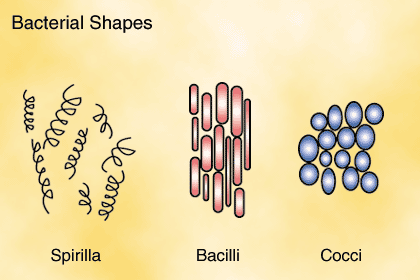
Bacteria tend to have three different shapes, sphere shaped bacteria (cocci), rod shaped bacteria (bacilli), and spiral shaped (spirilla).


The two different types of bacteria are archaebacteria and eubacteria. 

Archaebacteria were the first living things on earth. Archaebacteria can live in extreme environments including hot springs and acidic environments. They have also been found in the intestines of animals.

Eubacteria are also one celled prokaryotes. These bacteria, scientists believe, added oxygen to the Earth's atmosphere billions of years ago.


                                      Links

bacteria pic

fission gif

shapes of bacteria gif

information for article


Friday, November 22, 2013


                                         Let There Be Fire !!!!!!!!


Name of article: Why does Italy's Mount Edna keep erupting?
Source: for more facts about my article


Hey guys Thebestscienceblog 12 here and today I will talking about this eerie volcano found in Sicily,Italy.This article is about a constant erupting volcano that is terrorizing Sicily.


Mount Etna has been continuously been erupting in Sicily for the past 2,000 years. The last eruption was on November 28, 2013. The amount of lava that has been spewed can fill up the Chicago's Willis Tower ( the  former Sears Tower). 


Geologists are still trying to figure why this volcano erupts in so many different ways. Over the 2,000 years the volcano has been erupting in ways including quiet lava streams, spewing fire mountains, and even the dangerous pyroclastic flows(super heated mix of ash, lava fragments, and gases that run down volcano slopes). 


Geologists have come to the conclusion that when the magma deep below the volcano rises towards the surface it ascents at different speeds therefore effecting the eruption type. 

A fast lava ascent results in the lava keeping its air bubbles and making the eruption similar to that of a fizzy drink. While a slow lava ascent makes the magma lose air its bubbles resulting in lots of lava but little to no explosions.


I chose this story because I wanted to learn more and share about this interesting volcano. I predict that this volcano will keep on its current path and keep spewing lava over the Sicilian city. A question I have for you is in your opinion do you think geologists have the right reason for the constant eruptions or do you think there is a different cause for this? 

My opinion is that the geologists have the right reason for the cyclic eruptions.


                                        Links
volcano gif

pic of Mount Etna

video of Mount Etna

Monday, November 18, 2013

                                              The mysteries of Algae


                      Do you know what algae is??
Today I will be talking about the plant-like protists called Algae. Algae are the things you see in the spring and summer growing on ponds, rivers, and sometimes even lakes.


Algae are similiar to plants in ways like that use photosynthesis to gain food and that most algae are eukayotic, meaning they have nuclei. They differ because they don't have roots systems, leaves, and stems.

The different types of algae are diatoms, dinoflagellates, euglenoids, red algae, green algae, and brown algae. I know that sounds like a lot but they are actually quite easy to explain. 

First I will be talking about the three types of algae. The most important is the green algae. Green algae makes up almost half of the world's oxygen and is the most common type with many sub species.

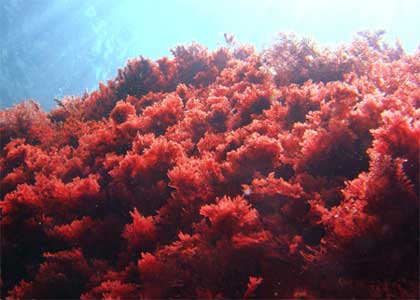
 Red algae is found deep under the sea and gets its food from photosynthesis. Carrageen, a substance found in red algae, helps make everday products like toothpaste and pudding smooth.


Brown algae live in the ocean and different types include seaweed and kelp.


Diatoms are gold brown in color giving them the name gold-brown algae. Diatoms are rich in silica which is a major ingredient in glass.

Dinoflagellates  have two flagella that help them move.  One acts as a belt while the other acts as a tail but they both rotate. Dinoflagellates are also available for red tide.  Red tide occurs when large amounts of dinoflagellates get together in the ocean.  This result in many deaths of fish from not getting enough oxygen.
Euglenoids have animal like features including flagella and eye spots that are sensitive to light.

Lastly some good things about algae are that they benefit humans in food and medicine. They also help by reducing harmful chemicals and carbondioxide emissions in the environment. In conclusion algae are great for you and me !!!!!

                                          Links